When you decide to buy a generator for your home or business, you should consider a number of factors before choosing your purchase. Before selecting a generator, it is important you understand how different systems perform under real-world conditions, especially in coastal and rural areas where outages can last longer and environmental factors play a bigger role.
Choosing the right generator for your home or business is all about having a solid understanding of fuel type, runtime expectations, and long-term reliability.
This guide breaks down the key considerations to help you choose the best generator for your property.

Understanding the Main Differences in Generators
The two primary differences in generators are:.
- Fuel type (gas, propane, or diesel)
- Cooling method (air-cooled, radiator-cooled, or water-cooled)
Each combination impacts how long your generator will run, how it performs during outages, and how well it holds up over time.
Below is a comparison of these issues for several scenarios that will help you decide what generator works best for your property.
How Long Do You Need Your Generator to Run?
The most important question to ask is when deciding how long you need your generator to run is what type of outage you are preparing for.
Obviously, the reason you need a generator is when the electricity from the utility grid is not available. Homeowners want to have a generator for that emergency backup when the power goes out.
That can happen for many reasons including:
- A wreck that hits a power line pole causing the power to be out for a few hours
- A bad thunderstorm that might keep the power out for a day
- A significant forest fire that impacts power transmission for a large area for several days
- A hurricane that impacts all sizes of power lines in several states for as long as two weeks.
In coastal regions like the Cape Fear Region of Eastern North Carolina, the worst case scenario is a hurricane, so fuel availability for up to two weeks is a significant issue to meet runtime critical factors.
Comparing Generator Fuel Types
Choosing the right fuel type is one of the most important decisions, as it determines how your generator performs during both short outages and extended emergencies. The type of fuel your generator uses has a direct impact on runtime, reliability, refueling options, and long-term performance.
Natural Gas
Natural gas generators are a common option for homes with access to a gas line.
If your location can connect to a natural gas line, a gas-fueled generator might be the best scenario for the generator to run continuously, but first, make sure that your connection to the gas line is sized properly to run the generator for your whole house.
Second, make sure that the community distribution line has enough pressure to run all the generators that are installed in that community.
Propane (LP Gas)
Make sure you have a tank that is large enough to run the generator for an extended, worst case scenario for two weeks. For a typical beach house that might require a 1000 gal tank. And research the restrictions on where and how that tank can be placed in relation to the house and the generator.
For example, propane tanks over 120 gal require a minimum distance to the house, and that distance may vary by location. Also tanks over a certain size are required to be buried.
Diesel Generators
Diesel fuel will run a generator five times longer than the same volume of gas.
For example, a 100 gal diesel tank will last 5 days longer than a 100 gal propane tank. For many large houses, the size of an LP gas tank to run for an entire week would need to be buried.
Another benefit for diesel is that it can be re-fueled easily. Greenfield Energy has a pickup truck with diesel tanks that can refuel the tank at a house during a storm. But a propane truck is too large to accomplish that task.
So, if you are choosing a generator for the worst case outage scenario in coastal regions, diesel is the better option. If you are choosing for the more common, shorter outages only, gas units will suffice.
See the Advantage of Diesel Generators Over Natural Gas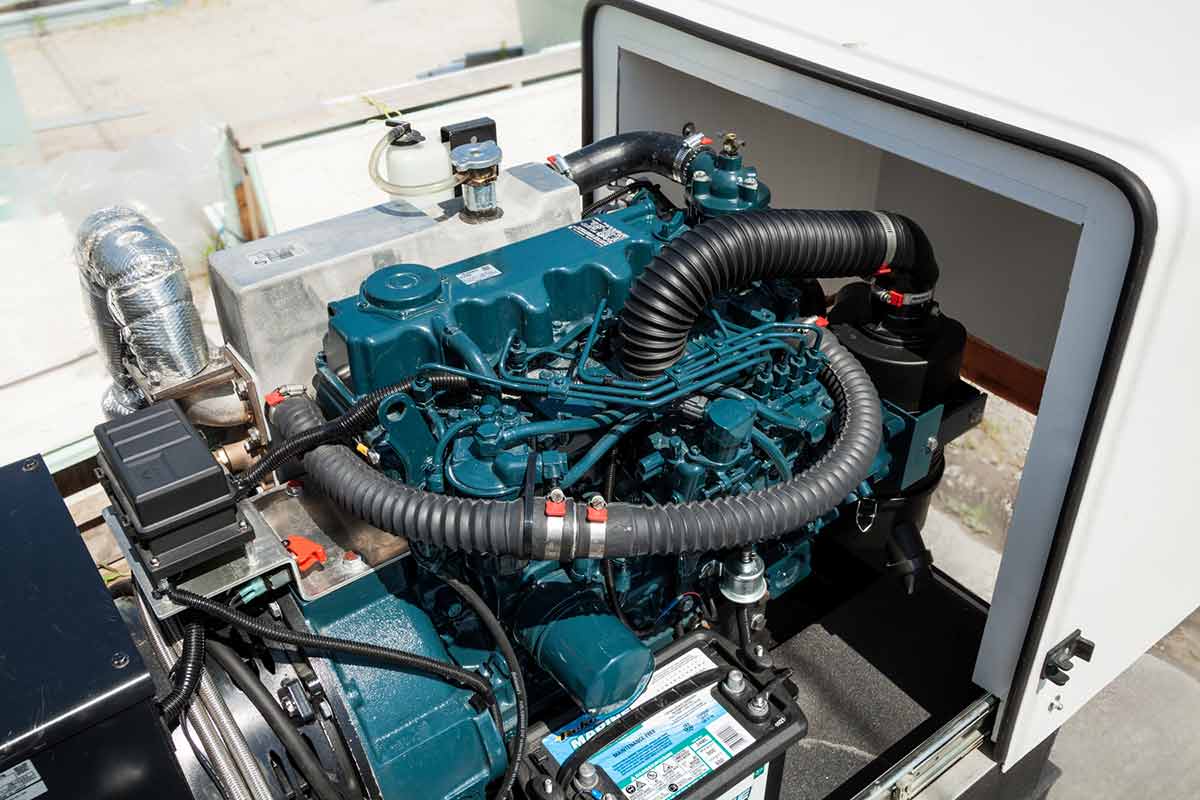
How Coastal Conditions Impact Generator Performance
In coastal regions like Eastern North Carolina, salt air is one of the biggest factors affecting generator lifespan.
Most generator systems rely on air for cooling, either directly or through a radiator. In these environments, salt-laden air is pulled into the system, accelerating corrosion on internal components and reducing overall lifespan, often limiting air-cooled systems to 8-10 years.
Salt air also impacts external components, including fuel lines. If a gas line corrodes, it can release pressurized fuel into the air, creating a potential safety hazard. Diesel systems, by comparison, use liquid fuel that leaks slowly and is easier to contain and manage.
Learn More About Generators on the CoastAir-Cooled Generators
For air-cooled generators, a radiator circulates water to cool the engine, but air still cools the radiator. The radiator saves the engine, but not the other system parts.
Air-cooled systems pull in outside air to regulate temperature and in coastal environments, this means salt air enters the system and internal components corrode over time.
Radiator-Cooled Generators
Radiator-cooled generator systems use liquid cooling for the engine, but still rely on air to cool the radiator. This protects the engine, but internal components remain exposed to salt air leaves corrosion as a long-term concern.
Water-Cooled (Heat Exchanger) Systems
The solution to this internal corrosion is Greenfield Energy’s unique HERO diesel generator system which uses a water-cooled heat exchanger with 2 water circulating systems. One cools the engine and the other cools the engine exhaust.
This design:
- Minimizes salt air exposure
- Reduces internal corrosion
- Extends system lifespan
With proper routine generator maintenance, these systems can last 20+ years.
The water that circulates through the heat exchanger can be from, and discharged to, a swimming pool, city water, creek or waterway.
Noise Considerations & HOA Restrictions
Noise can be an overlooked factor when choosing a generator.
Gas-fueled generators run at 3600 rpm and are much louder than diesel generators that run at 1800 rpm. Consequently, many gas generators do not meet the HOA noise restrictions.
During a storm, this is probably going to be overlooked, but all generators are set to exercise 10 to 30 minutes every week and that noise will be an issue for many neighbors.
Greenfield Energy’s diesel HERO system has even more noise attenuation because it is in a fiberglass enclosure with additional insulation to reduce sound levels. Most other generators are in metal enclosures.
How Much Does a Generator Cost?
The cost of a generator goes beyond the initial purchase. It’s important to consider installation, maintenance, and long-term operating costs when comparing different systems.
Initial Cost
Gas generators often appear less expensive upfront as they typically cost less than a diesel generator, but separate costs are incurred for the LP tank or natural gas tap fee and line run from the street to the generator.
A diesel generator system is an all-inclusive price with fuel tank included and attached to the generator, making the system cost approximately the same for the same sized generator. The larger the generator size, the more likely it will cost more for the gas system if the natural gas line is farther from the house, or the LP tank is required to be buried, in addition to being farther from the house.
Learn More About Our Generator Installation ServicesMaintenance Costs
Gas generators require an oil change every 100 hours, which would be only four days into a worst scenario case. Diesel generators require an oil change only every 500 hours.
This significantly reduces long-term maintenance costs for diesel systems.
Total Cost of Ownership
When factoring in higher maintenance costs and a lifetime of only 8 to 10 years for a gas generator as described above, the gas system has a higher lifetime total cost than a diesel system with lower maintenance costs and an average of 20+ years lifetime.
Environmental Impact
Contrary to popular belief, new emission requirements have made diesel generators cleaner for the environment than natural gas generators. Natural gas engines emit more carbon dioxide than diesel generators.
Need Help Choosing the Right Generator?
Every property is different and the right generator depends on more than just size or price.
If you are buying a small generator for a small house in a typical outage, a gas-fueled generator might be the cheapest and easiest option. But if you are buying a generator for the worst case scenario in a coastal region, and for a larger house, the Greenfield Energy HERO system would be your best option.
If you need help choosing the right generator for your property, Greenfield Energy can evaluate:
- Power requirements
- Fuel access
- Environmental exposure
- Runtime expectations
to recommend the best system for your needs.
Request a consultation today or give us a call at 910-509-1805 to find the right generator for your property.